

California Retirement Tax Series: Part 2 of 3
In What Order Should I Withdraw From My Retirement Accounts in California?
There is no single withdrawal order that is right for everyone, but the sequence you choose directly affects your California tax bill. Because California taxes traditional 401(k) and IRA withdrawals as ordinary income at rates up to 13.3% (California Franchise Tax Board), the order in which you draw from taxable, tax-deferred, and Roth accounts can change how much of your savings you keep.
Key Takeaways
- The three account types, taxable, tax-deferred, and Roth, are taxed differently, so the drawdown order affects your California tax bill.
- A common general sequence is taxable accounts first, then tax-deferred, then Roth, but the right order depends on your brackets and goals.
- Required minimum distributions from traditional accounts generally begin at age 73 (IRS), which limits how long tax-deferred money can be left untouched.
- California taxes traditional withdrawals as ordinary income at 1% to 13.3% and does not tax qualified Roth withdrawals (California Franchise Tax Board; IRS).
- Coordinating withdrawals with Social Security timing can affect how much of your benefit is federally taxable (IRS).
Why Does Withdrawal Order Matter in California?
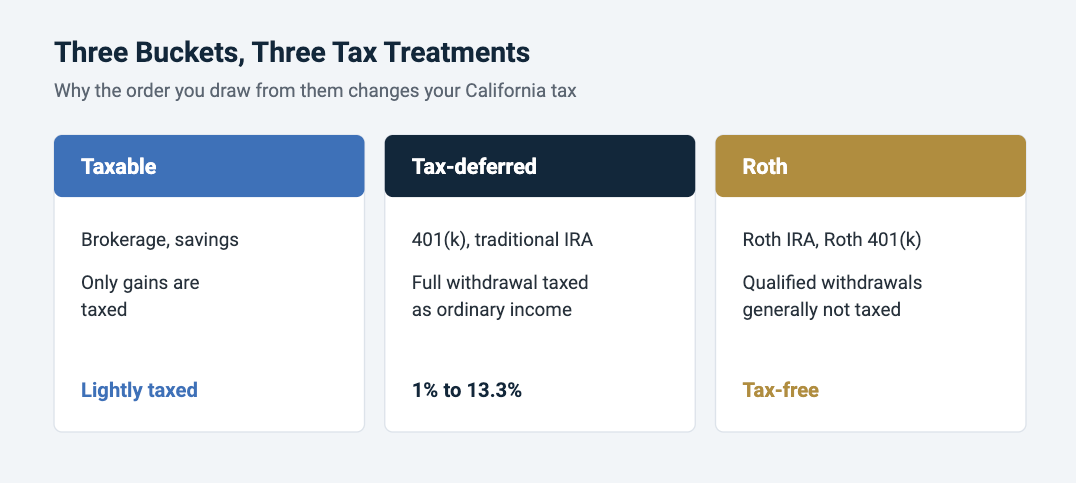
Withdrawal order matters because your accounts are taxed in three different ways, and California applies its high ordinary-income rates to one of them. Money in a taxable brokerage account has already been taxed, so only gains are taxed when you sell. Money in a traditional 401(k) or IRA has never been taxed, so every dollar you withdraw is ordinary income to California (California Franchise Tax Board). Money in a Roth account was taxed before it went in, so qualified withdrawals come out tax-free (IRS).
When you pull from these buckets in different orders, you change your taxable income in each year of retirement. In a state with brackets that reach 13.3%, that timing has real weight. The goal is not simply to pay less tax this year. It is to smooth your taxable income across many years so you are not forced into higher brackets late in retirement, which is where thoughtful tax strategies earn their keep.
What Is the Common Order for Drawing Down Accounts?
A frequently cited general approach is to spend taxable accounts first, then tax-deferred accounts, then Roth accounts last. The reasoning is that this lets tax-advantaged accounts keep growing while you live on money that is taxed lightly, and it preserves tax-free Roth dollars for as long as possible.
That order is a starting point, not a rule. For some retirees, drawing a measured amount from a traditional IRA earlier, while in a lower bracket, prevents a much larger required distribution later. The right sequence depends on your bracket today, your projected bracket in later years, and what you want to leave behind.
| Account type | How California taxes withdrawals |
|---|---|
| Taxable brokerage | Only gains taxed, as ordinary income for residents (CA FTB) |
| Tax-deferred (traditional 401(k), IRA) | Entire withdrawal taxed as ordinary income, 1% to 13.3% (CA FTB) |
| Roth (IRA, 401(k)) | Qualified withdrawals generally not taxed (IRS) |
How Do Required Minimum Distributions Change the Plan?
Required minimum distributions, or RMDs, put a limit on how long you can leave traditional accounts alone. Under current federal rules, RMDs from traditional 401(k) and IRA accounts generally begin at age 73 (IRS). Once they start, you must withdraw a minimum amount each year whether you need the income or not, and California taxes that amount as ordinary income.
This is why leaving a large traditional balance untouched until age 73 can backfire. A big required distribution, stacked on Social Security and other income, can push a retiree into a higher California bracket than if smaller withdrawals had been spread across earlier, lower-income years. Planning the drawdown before RMDs begin is often where the tax savings live, and it is a central piece of retirement planning.
How Does Social Security Timing Fit In?
California does not tax Social Security, but the federal government can tax up to 85% of your benefits depending on your other income (IRS). Because traditional account withdrawals raise that other income, the order and size of your withdrawals can affect how much of your Social Security becomes federally taxable. Coordinating when you claim Social Security with when you draw from tax-deferred accounts is part of a complete withdrawal strategy, not a separate decision.
Frequently Asked Questions
What order should I withdraw retirement accounts in California?
There is no universal order. A common general approach is taxable accounts first, then tax-deferred, then Roth, but the right sequence depends on your California brackets, your projected future income, and your goals (California Franchise Tax Board).
At what age do required minimum distributions start?
Under current federal rules, required minimum distributions from traditional 401(k) and IRA accounts generally begin at age 73 (IRS). California taxes those distributions as ordinary income.
Does the order I withdraw affect my California taxes?
Yes. Because California taxes traditional withdrawals as ordinary income at rates up to 13.3% and does not tax qualified Roth withdrawals, the drawdown order changes your taxable income each year and your lifetime tax bill (California Franchise Tax Board; IRS).
Does California tax Roth IRA withdrawals?
Qualified Roth IRA withdrawals are generally not taxed by California or the federal government, because the money was taxed before it was contributed (IRS).
Want Help Mapping Your Withdrawal Sequence?
The right drawdown order depends on your accounts, your brackets, and your timeline, and it is easier to see with your full picture in front of you. The team at Legacy Finance in Old Town Clovis can help you think through how to sequence withdrawals across your accounts. Within an advisory relationship, Legacy Finance serves as a fiduciary, required to act in your best interest.
Schedule a Consultation(559) 297-8080This article is for general informational purposes only and is not intended as tax, legal, or investment advice. Tax rules change and apply differently to each person; please consult a qualified tax professional regarding your individual situation.